


You asked three vendors for a quote on office glass partitions. You got three completely different numbers.
That is not unusual, and it is not necessarily because one vendor is cheating you. Office glass partition cost in India genuinely varies based on a long list of factors that most basic quotes do not explain upfront. Glass type, frame system, thickness, door hardware, frosting, installation complexity, transport, and GST can all sit outside a headline per sq. ft. rate, until the final invoice arrives.
India’s commercial office market makes this more relevant than ever. According to JLL, India absorbed over 60 million sq. ft. of Grade A office space in 2024, with Bengaluru, Hyderabad, Mumbai, Delhi NCR, and Pune driving most of that demand. More businesses are fitting out new offices, upgrading existing ones, or reconfiguring layouts to support hybrid work, and glass partitions have become one of the most commonly specified elements in those projects.
Yet pricing confusion remains one of the biggest frustrations buyers face. This guide breaks down every factor that changes the final office glass partition cost in India. By the end, you will know what drives the price, what to look for in a quote, and how to make a decision that serves your office for years, not just one that looks cheapest on paper. Because the right partition is not the one with the lowest number. It is the one that delivers privacy, safety, durability, and the right impression for your space, within a budget that is clearly understood from the start. For commercial spaces where glass thickness, safety, and finish need to be selected carefully, Timbergloss provides glass partitions and office solutions based on the project’s design and usage requirements.
How Glass Thickness Affects Office Glass Partition Cost
When two glass partition quotes look similar on paper but differ in price, the difference is often due to glass thickness. It is one of the most technical factors in office glass partition cost in India, and one of the least explained by vendors at the quoting stage.
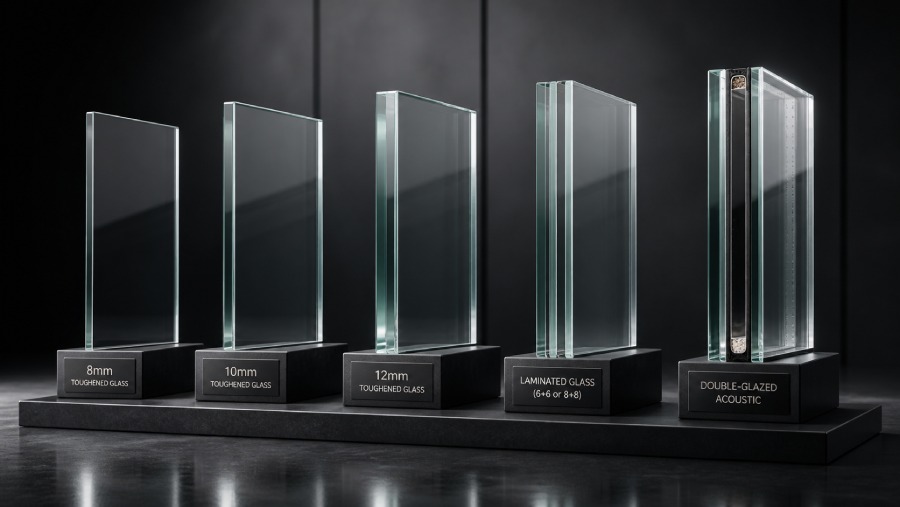
The Most Common Thickness Options for Office Partitions
In commercial office fit-outs across India, toughened glass partitions are most commonly specified in the following thicknesses
| Glass Thickness | Common Application | Cost Impact |
|---|---|---|
| 8mm toughened glass | Low-height or lightweight partitions | Lower cost, limited application |
| 10mm toughened glass | Standard office cabins, general partitions | Mid-range, most widely used |
| 12mm toughened glass | Full-height partitions, frameless systems | Higher cost, stronger, and more stable |
| Laminated glass (6+6 or 8+8) | Acoustic and safety-critical areas | Significantly higher cost |
| Double-glazed acoustic units | Boardrooms, high-performance meeting rooms | Premium cost |
For most commercial offices in India, 10mm toughened glass is the standard specification. It offers a practical balance of strength, weight, cost, and compatibility with standard aluminium frames and door hardware.
12mm toughened glass is typically specified where full-height partitions are required, where the design calls for a frameless or minimal-frame system, or where the structural load needs greater rigidity. The additional cost comes not just from the glass itself but from heavier hardware, more precise installation tolerances, and the handling complexity of thicker panels on-site.
Why Laminated and Acoustic Glass Costs More
Laminated glass consists of two or more glass layers bonded with an interlayer, most commonly PVB (polyvinyl butyral). This construction keeps the glass intact if broken, which improves both safety and sound performance.
According to the Bureau of Indian Standards, toughened safety glass used in partitions must comply with IS 2553 Part 1, while laminated glass falls under IS 6479. Specifying compliant glass, especially in commercial buildings, matters both for safety and for building approval requirements in many Indian cities.
The cost difference between standard toughened glass and laminated acoustic glass can range from 40% to over 100%, depending on the specification. But for meeting rooms, boardrooms, HR cabins, and finance areas, where sound privacy directly affects how the space functions, the performance difference is just as significant as the price difference.
Aluminium Frame vs Frameless Glass Office Partitions Cost
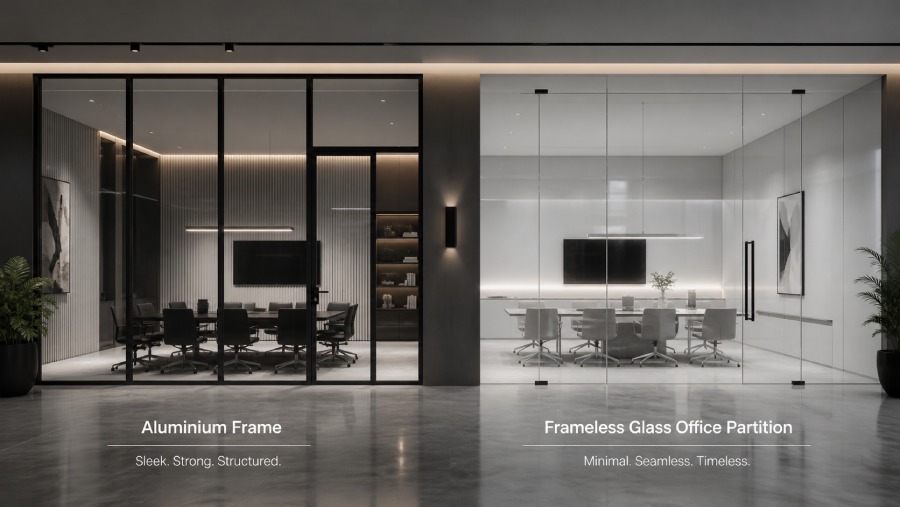
The frame system also has a major impact on the final glass office partitions cost.
Aluminium-framed glass partitions are the most practical choice for many commercial offices. The frame supports the glass, protects the edges, and makes it easier to integrate doors, locks, and seals. It is also easier to maintain and usually more cost-effective than frameless systems.
The cost can change depending on the aluminium profile, colour, finish, and thickness. Standard aluminium profiles are usually more economical. Powder-coated profiles, slim-line frames, black frames, and custom finishes increase the price but give a more refined office look.
Frameless glass partitions are more premium. They create a cleaner, more minimal appearance because the visible frame is reduced. However, frameless systems usually need thicker glass, better hardware, patch fittings, floor channels, and more precise installation. This is why they cost more.
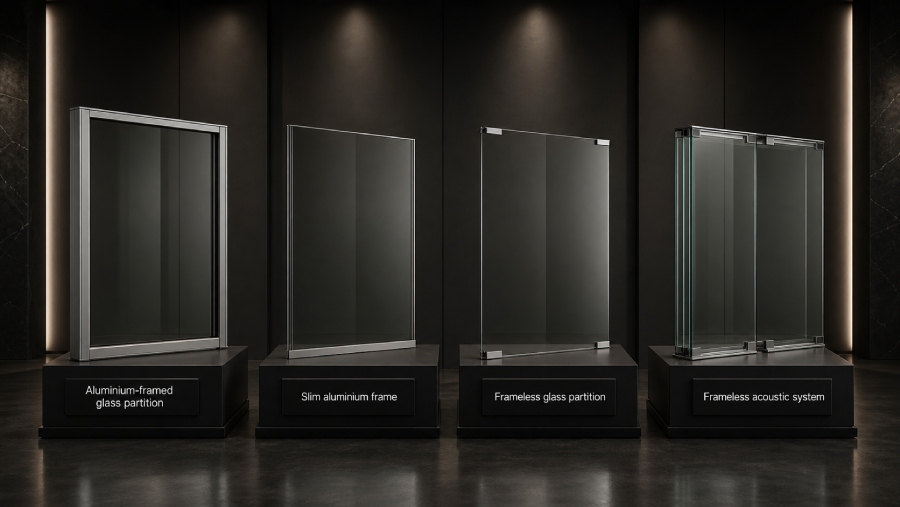
| System Type | Cost Impact | Best For |
|---|---|---|
| Aluminium-framed glass partition | Lower to mid | General offices, cabins, meeting rooms |
| Slim aluminium frame | Mid | Modern commercial interiors |
| Frameless glass partition | Mid to high | Premium cabins and client areas |
| Frameless acoustic system | High | Boardrooms and leadership spaces |
For most offices, a mix works best. Aluminium-framed systems can be used in high-traffic zones, while frameless glass can be reserved for reception areas, director cabins, or premium client-facing spaces.
Timbergloss also designs aluminium-framed glass doors and partition systems for corporate offices, hospitality spaces, and commercial interiors.
Height, Area, and Layout
Partition height and layout can change the final office glass partitions prices more than many buyers expect.
A low-height divider uses less glass and is easier to install. A full-height partition, from floor to ceiling, needs more glass, heavier panels, better alignment, and stronger support. This naturally increases cost.
The total area also matters, but not in a simple way. A straight glass wall is easier and more cost-efficient to install than a layout with many cabins, corners, angles, and small glass panels.
Cost usually increases when the layout includes
- Multiple cabins
- Too many corners and joints
- Narrow or irregular glass panels
- Angled partitions
- Full-height glass walls
- Multiple door openings
- Complex ceiling or floor junctions
For example, four long glass partition runs may be easier to install than twelve small cabins, even if the total glass area is similar. More cabins mean more doors, more hardware, more joints, and more installation time.
This is why a site measurement or layout review is important before final pricing. A rough per sq. ft. quote may be useful for budgeting, but it cannot show the exact glass office wall price until the layout is properly reviewed.
Doors and Hardware
Doors and hardware are often the reason one quote is much higher than another. Many basic quotes show only the partition rate and leave doors, locks, hinges, handles, floor springs, and sliding systems as separate items.
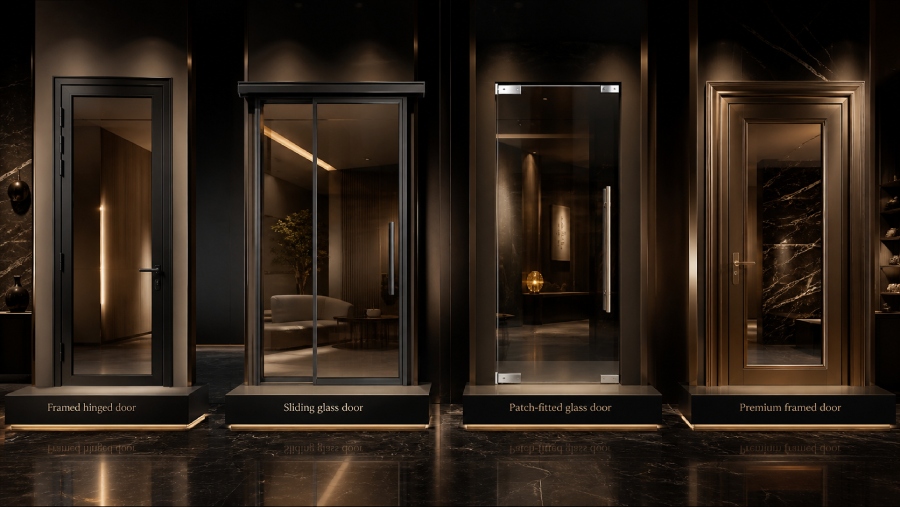
Common office glass partition door types include
| Door Type | Cost Impact | Best Used For |
|---|---|---|
| Framed hinged door | Lower to mid | Standard cabins and high-use areas |
| Sliding glass door | Mid to high | Space-saving rooms and flexible zones |
| Patch-fitted glass door | High | Frameless and premium cabins |
| Premium framed door | Mid to high | Meeting rooms and boardrooms |
Hardware quality matters because office doors are used every day. Poor-quality hinges, rollers, locks, or floor springs may reduce the initial cost, but they can lead to noisy doors, alignment issues, loose fittings, and frequent maintenance.
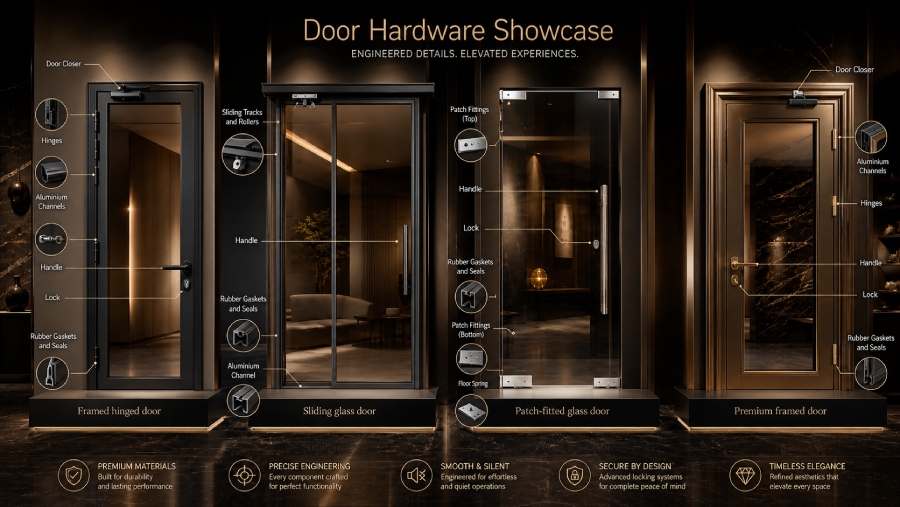
Important hardware items include
- Handles
- Locks
- Hinges
- Patch fittings
- Floor springs
- Sliding tracks and rollers
- Door closers
- Aluminium channels
- Rubber gaskets and seals
For meeting rooms and cabins, hardware also affects privacy and sound control. Even good glass will not perform well if the door has gaps or weak sealing.
Before comparing office glass partition cost, check whether the doors and hardware are included in the quote. If they are not clearly mentioned, the final project cost may increase later.
Frosted Glass Partition Cost: Privacy, Branding, and Design Finish
Clear glass opens a space up. Frosted glass gives it purpose.
Privacy, hierarchy, branding, and visual calm; frosting does more functional work per square foot than almost any other finish decision in an office interior. Yet it is regularly treated as an afterthought, added to a partition quote at the last minute rather than designed into the space from the start.
Frosted Film vs Etched Glass: What Is the Difference?
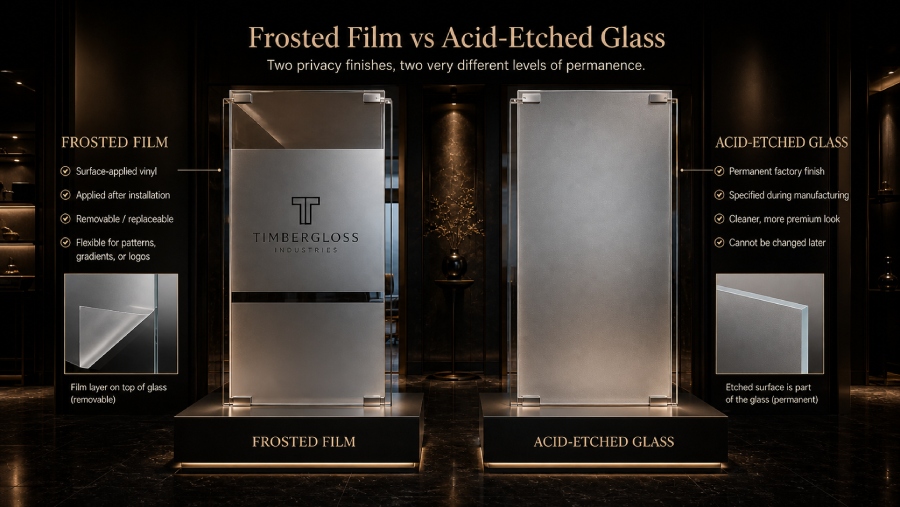
Frosted film is a self-adhesive vinyl applied to the glass surface after installation. Practical, flexible, and the most widely used privacy finish in Indian commercial offices. It can be applied in full coverage, gradients, cut patterns, or custom logo formats, and removed or replaced if the office rebrands or reconfigures.
Acid-etched glass is a permanent finish applied during manufacturing. It looks cleaner and more premium at close inspection, but cannot be changed once specified.
For most leased commercial offices in India, frosted film is the more practical specification. Acid-etched glass makes sense in owner-occupied spaces where permanence is a genuine advantage.
Types of Frosting and Where Each Works
| Frosting Type | Privacy Level | Best Applied In |
|---|---|---|
| Full frosting | High | HR, finance, legal, leadership cabins |
| Gradient frosting | Medium | Reception-facing cabins, collaborative zones |
| Band frosting | Medium | Standard cabins, meeting rooms |
| Logo and pattern film | Visual | Reception backdrops, branded meeting rooms |
| Manifestation markings | Low | Large clear glass walls — safety compliance |
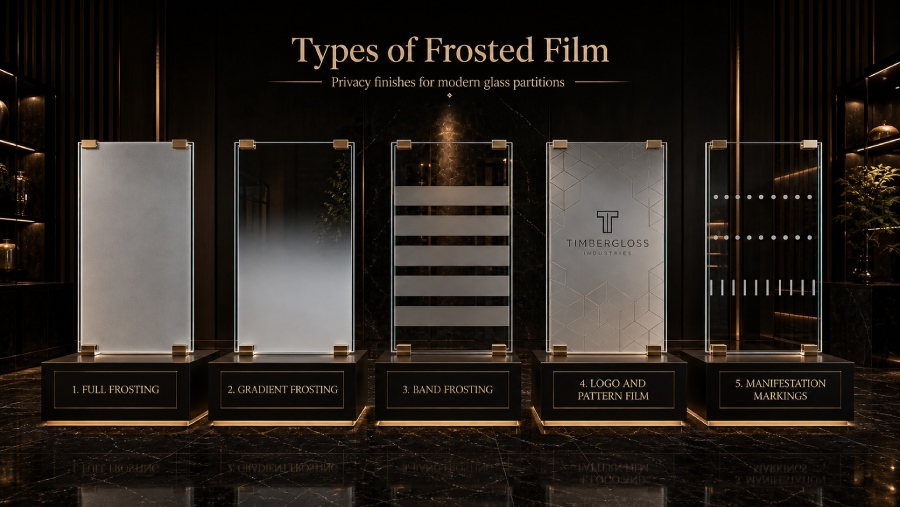
Gradient frosting — transitioning from opaque at eye level to clear above and below is one of the most specified finishes in design-led offices across Mumbai, Bengaluru, and Delhi NCR. It balances privacy with openness without making a space feel enclosed.
Logo and pattern frosting turns a partition into a brand asset. In reception areas and
client-facing rooms, branded glass finishes communicate company identity more effectively than almost any other low-cost intervention in an office interior.
Manifestation markings serve a specific safety function; many commercial buildings in India require visual markers on full-height clear glass panels to prevent collision. Low cost, but non-negotiable where required.
Smart Glass Office Partitions: Premium Cost, Strong Privacy Value
There is a moment in almost every boardroom presentation where someone reaches for the blinds. Smart glass eliminates that moment entirely.
At the flick of a switch, smart glass transitions from fully transparent to completely opaque. No blinds, no curtains, no manual intervention. For the right spaces, it is one of the most functionally impressive specifications in commercial interior design today.
How It Works
Most commercial office smart glass in India uses PDLC technology: Polymer Dispersed Liquid Crystal. A liquid crystal film is laminated between two glass layers or applied as a retrofittable film. Current on, glass is clear. Current off, glass turns opaque instantly.
Where It Genuinely Makes Sense
Smart glass carries a significant cost premium. That premium is justified in specific situations
- Boardrooms facing open office floors — on-demand privacy without blinds or permanent frosting. The transition takes under a second and can be controlled by a wall switch, remote, or building automation system.
- Director and C-suite cabins — where privacy is needed intermittently rather than permanently. Visible and open during the day, private during sensitive calls or meetings.
- Premium client-facing environments — law firms, financial services, private healthcare — where the quality of the environment directly affects client perception.
Outside these scenarios, smart glass adds cost without adding proportionate functional value to the day-to-day operation of a standard commercial office.
What Drives the Cost
Three factors push smart glass significantly above standard partition costs
- The technology itself — PDLC glass carries a material cost premium over standard toughened or laminated glass regardless of supplier.
- Electrical integration — Smart glass requires low-voltage wiring, switching controls, and in larger installations, building automation integration. This must be executed by a qualified electrical contractor — not added informally after installation.
- Early planning is non-negotiable — Electrical conduits, switch positions, and power routing must be resolved at the design stage — before ceilings are closed and floors are finished.
Retrofitting smart glass into a completed fit-out is significantly more expensive and disruptive than specifying it from the start.
Acoustic Performance: Why Meeting Rooms Cost More Than Open Partitions
A basic glass partition can divide a space visually, but it may not control sound properly. This is why meeting rooms, boardrooms, HR rooms, finance rooms, and director cabins often cost more than open glass dividers.
Acoustic performance depends on the full system, not only the glass thickness. The partition may need laminated glass, double-glazed panels, better aluminium profiles, acoustic seals, proper door closing, and careful installation.
One common mistake is assuming that thicker glass alone will solve noise issues. Sound can still pass through gaps around doors, floor channels, ceiling joints, and poorly sealed edges.
Acoustic glass partitions are useful for
- Boardrooms
- Meeting rooms
- HR and interview rooms
- Finance and legal departments
- Director cabins
- Client discussion rooms
If the office only needs visual separation, a standard glass partition may be enough. But if confidential conversations happen inside the room, acoustic requirements should be planned from the beginning. Fixing sound issues later is usually more difficult and more expensive.
GST, Transport, Installation, and Site Conditions
Many office glass partition quotes look affordable because they show only the material rate. The final cost may increase once GST, transport, loading, unloading, installation, wastage, site protection, and finishing work are added.
A proper quote should clearly mention
- Glass type and thickness
- Aluminium frame or channel
- Door hardware and locks
- Frosting or privacy film
- Transport and delivery
- Loading and unloading
- Installation labour
- GST
- Warranty or service support
Site conditions can also affect the final glass office wall price. A clean and ready site is easier to install. A site with uneven floors, ceiling level differences, limited access, or existing services may need extra adjustment and labour.
Common site factors that affect cost include
- Uneven floor or ceiling levels
- Existing false ceiling design
- Electrical points in the partition line
- HVAC ducts, sprinklers, or lighting conflicts
- High-rise access restrictions
- Service lift limitations
- Working inside an occupied office
- Night or weekend installation requirements
- Limited parking or loading access
This is why the final quote should be based on actual site conditions, not only a standard rate card. A site visit helps avoid missing costs and last-minute changes during installation.
Glass Office Partitions vs Solid Walls: Which Gives Better Long-Term Value?
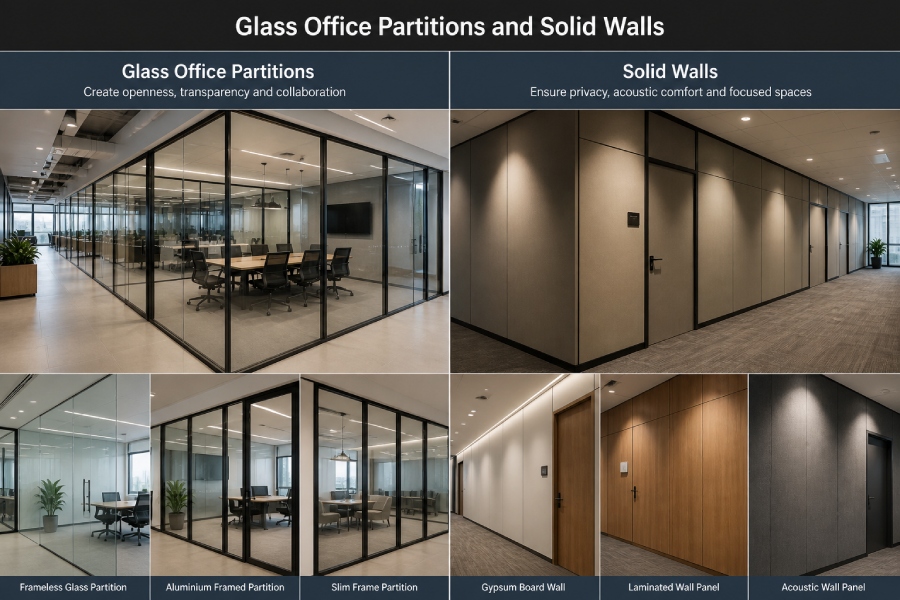
Solid walls may offer stronger privacy, but they can make an office feel smaller, darker, and less flexible. Glass partitions allow light to move through the workspace while still creating cabins, meeting rooms, and focus areas.
In some cases, the office glass partition cost may be higher than a basic solid wall, especially when you include toughened glass, aluminium frames, doors, hardware, and frosting. But the long-term value can be stronger in modern offices.
Glass partitions support
- Better daylight flow
- A more open office feel
- Visual connection between teams
- Flexible space planning
- A premium client-facing appearance
- Easier reconfiguration compared to permanent walls
Solid walls still make sense for storage rooms, service areas, or spaces needing complete privacy. But for cabins, meeting rooms, and collaborative office zones, glass partitions often give a better balance of openness, privacy, and design.
How to Control Office Glass Partition Cost in India
You can control office glass partition cost without compromising the final result if the planning is done properly.
Practical ways to manage cost include
- Keep the layout simple where possible
- Avoid too many angled partitions or small glass panels
- Use standard glass sizes to reduce wastage
- Choose aluminium-framed systems for high-use areas
- Use frameless glass only where the premium look matters
- Add frosting only in rooms that need privacy
- Use acoustic glass only for confidential rooms
- Finalise ceiling, flooring, HVAC, and electrical points before installation
- Select hardware based on usage, not only appearance
- Work with one design and fit-out team to avoid coordination mistakes
Cost control does not mean choosing the cheapest option everywhere. It means spending where performance matters and simplifying where the specification does not need to be premium. Working with a specialised glass and aluminium company in India can help reduce coordination gaps between design, fabrication, hardware, and installation.
For example, an open work area may only need a standard framed partition, while a boardroom may need acoustic glass, better sealing, premium hardware, and privacy film. This type of planning keeps the budget practical without weakening the office experience.
Questions to Ask Before Finalising a Glass Partition Quote
Before approving a quote, ask the contractor these questions
- What glass thickness is included?
- Is the glass toughened, laminated, acoustic, or clear standard glass?
- Is the aluminium frame or channel included?
- Are doors, handles, locks, hinges, and floor springs included?
- Does the price include frosting, branding film, or privacy film?
- Are transport, loading, unloading, and installation included?
- Is GST included or excluded?
- Is there a warranty on hardware and workmanship?
- Will the team visit the site before finalising the cost?
- Who will coordinate with ceiling, flooring, electrical, HVAC, and other fit-out work?
These questions help you compare office glass partitions prices properly. Instead of choosing based only on the lowest rate, you can understand what is included, what is missing, and whether the contractor can handle the project professionally.
Need a Clear Estimate for Your Office Glass Partition?
A clear quote starts with a clear layout. Share your office plan, cabin sizes, door positions, privacy needs, preferred finish, and site conditions before comparing prices.
At Timbergloss, we help businesses choose the right glass partition system for the way their office will be used. The goal is not to over-specify where it is unnecessary, and not to cut corners where durability, privacy, safety, or finish matter.
Planning office glass partitions in India? Connect with Timbergloss for a practical estimate based on your layout, site condition, and budget.